xanike made me ascend out of the physical realm and into an astral plane
Honka and Xanike are on opposite sides of the spelling spectrum
the answer to “how do you spell Hanukkah” is “with a different alphabet”
Gather round, my children, and let me tell you how to spell this pesky word.
I’ll start by what everybody agrees on in the spelling: the vowels. Everybody agrees that they go -a-u-a- (I’m using the dashes to denote possibly missing consonants for now).
You may have noticed the 2 different spellings of The Word in Hebrew above:
חֲנֻכָּה: the original word, in which the /u/ portrayed in
נֻ (/nu/) is a short one. BiblicalHebrew distinguished between long vowels, short vowels, and half-sized vowels. Due to Biblical Hebrew syllable-structure shenanigans, the /u/ is short.
חנוכה: the modern way of writing the word. The נו (/nu/) would have denoted a long vowel in Biblical Hebrew … but Modern Hebrew does not distinguish vowels by length.
The first /a/ (in
חֲ) used to denote a half-length vowel. Since vowel-length doesn’t mean anything anymore in Hebrew, both /a/ are equal.
Therefore, in Modern Hebrew,
חנוכה =
חֲנֻכָּה.
That covers the vowels. Next, the bits where everybody who knows even a bit of transliteration would agree on:
There’s only 1 /n/. That means it’s -anu-a-.
There are 2 /k/ after the /u/. That’s because the Hebrew is
כָּ. You see the little dot in the middle? That used to mean that the sound used to be geminated. We don’t really observe gemination in Modern Hebrew anymore, except that in some letters (v, f, ch) the little dot (dagesh) denotes something very important.
In case you don’t want to double the K, because the language that you’re using, AKA English, that doubling means absolutely nothing, you can skip it.
This leaves us with -anuk(k)a- as a definite spelling so far.
This is where things get murky. Because you see … this is when the transliteration rules start falling apart by way of a long tradition of transliteration as well phonology rules across several languages in the duration of about 2000 years.
The beginning
ח: is it h, kh, or ch? Frankly, it could be any of these.
KH: This is the transliteration of a sound in Hebrew that no European language has or has had. Standard Modern Hebrew doesn’t have it anymore, but it’s still considered an acceptable, very common variance of the consonant ח. In linguistics, it’s written as [
ħ
], and in Semitic studies, it’s written as
ḥ (an h with a little dot below it). You can listen to it [here on Wikipedia]. This is the classical, old-fashioned, origins-faithful spelling … which looks very very wrong: Khanukka-. Weird, right? Still correct.
If you listened to the recording, you might think it sounds between an /h/ and an /x/ (as in ‘ch’ in the Scottish Gaelic word for lake ‘loch’), depending on which sound you preferred.
H is how the Greeks transliterated the letter ח in the Bible (such as in the second h in the word ‘Bethlehem’)
CH is how Standard Modern Hebrew pronounces via the Ashkenazi pronunciation of Yiddish.
So if you spell it with a KH, you’re an out-of-date traditionalist; if you spell it with an H, you’re faithful to the name of the holiday in your own language, and if you spell it with a CH you’re faithful to the Standard Modern Hebrew pronunciation (and probably have family who speaks either Hebrew or Yiddish).
Possible, correct options so far:
Khanuk(k)a-
Hanuk(k)a-
Chanuk(k)a-
Which leads us to the very last dash! Is there an H at the end? Should there be an H at the end?
This is where it gets the most complicated, because it requires some background in Hebrew noun-noun constructs.
The word ‘
חנוכה
‘ is an actual word in Hebrew that means ‘inauguration, dedication, consecration‘ according to morfix.co.il (the Hebrew-English-Hebrew web translator). Since Hebrew is a gendered language, The Word is a feminine noun. A lot of feminine nouns in Hebrew end with what can be directly transliterated as ‘-ah’, or, in Hebrew, a word-final ‘
ה
‘ (the name of this letter is either He or Hey, depending on how much official Hebrew education the person had).
This Hey is silent. It hanging around does not mean there’s an /h/ sound in the word. All it does is tell the user of the language that they should pay attention to this word, because in noun-noun constructs, the Hey becomes a Tav (or Taf). This was ‘inauguration of [noun]’ is חנוכת-בית (khanukkat-bayit in pefect translit; ‘bayit’ is ‘house’ or ‘home’).
So, it’s really up to you whether to add that last H or not.
What you should be careful of, probably, is mix-and-matching. Khanuka is just outright weird, because you’re mixing a bunch of translit styles – going from extreme translit mode (KH) to mild mode (one K, no H). Chanuka also looks strange, because the CH is also somewhat strict-ish translit.
This all means that these are all the correct spellings in English, from a Hebrew standpoint, from most-strict transliteration to the most permissive:
Khanukkah
Chanukkah
Hanukkah
Chanukka (h is silent, double-k still serves a phonetic purpose that I didn’t bother going much into)
Hanukah
Hanukka
Hanuka (as much as it makes me twitch)
You’re welcome, and may you all confuzzle everybody you come across!
I want men to try and imagine going about your day–working, running, hiking, whatever–and not being allowed to wear pants under threats of violence or total social and economic exclusion.
That’s the kind of irrationally violent and controlling behaviour women have been up against.
Also for anyone who thinks it’s easy for women to be gender non conforming because we can wear pants.
The only reason we can is because we fought tooth and nail for the right to! Any rights we take for granted today we’re the result of a prolonged, bitter battle fought by our predecessors for every inch of territory gained. Never forget that.
Title IX (1972) declared that girls could not be required to wear skirts to school.
Women who were United States senators were not allowed to wear trousers on the Senate floor until 1993, after senators Barbara Mikulski and Carol Moseley Braun wore them in protest, which encouraged female staff members to do likewise.
This was never given to us. Women have had to fight just to be able to wear pants. Women who are still alive remember having to wear skirts to school, even in the dead of winter, when it was so cold that just having a layer of tights between them and the elements was downright dangerous. Women who remember not even being allowed to wear pants under their skirts, for no other reason than they were female.
So don’t talk about women wearing pants being gender nonconforming like it’s easy. It’s only less difficult now because your foremothers refused to comply.
My mother spent her entire school career up until high school having to wear skirts, no matter how horrible the New England winters got, because she was forbidden to do otherwise. There were times when the weather was bad where my grandmother kept her home rather than make her walk to and from the bus in a skirt.
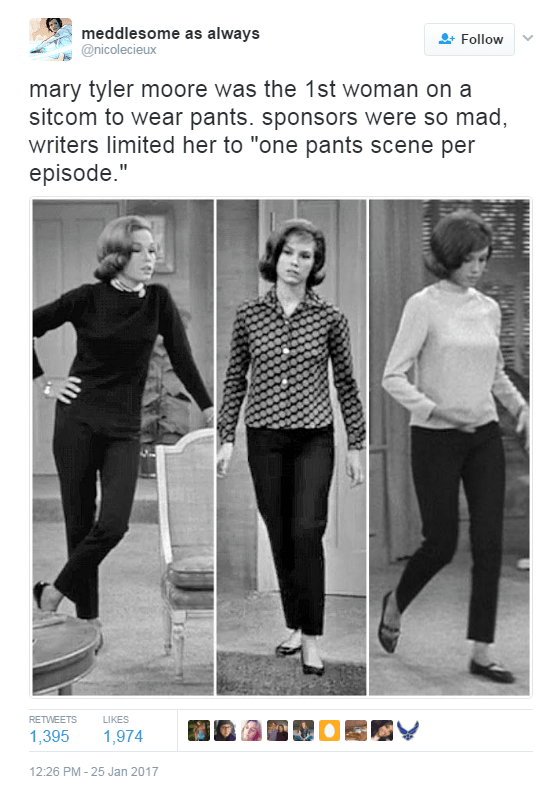
They rebroadcast a few old interviews with Mary Tyler Moore, and in them she addressed the pants issue. There was a strict limit on what kind of pants she could wear (hence, always Capri pants, nothing masculine), and to use her words, how much cupping the pants could show. A censor would look at every outfit when she came out on stage, and if the pants cupped her buttocks too much, defining them rather than hiding them, then she had to get another pair.
A prime example of how gender is socially enforced.
I remember a prolonged battle at primary school, with petitions and numerous near riotous PTA meetings before girls were allowed to wear trousers. In the late 1990s/early 2000s. In Scotland. A country which now (rightly, for the most part) prides itself on its progressiveness. Please don’t ever take these things for granted, and don’t assume that it’s only far flung places that you have nothing in common with that took so long to catch up. We’re all still fighting, little by little, for every apparently trivial victory that mounts up until we can reach the non-trivial ones. And we can’t afford to stop.
At my private Catholic high school, girls were only given the green light to wear pants the year before I began attending.
In 1992.
Yeah, 1991, forced to wear dresses in school. Got detention once because after school was over while waiting for my ride outside I took off the dress that was over my button down shirt and normal-kids-shorts-length shorts because it was Louisiana degrees outside and I was 7.
Teachers were forced to wear skirts for years. And heels. My mother’s feet are still high heel shaped when she takes off her shoes. She had to wear a skirt till I was well into junior high.
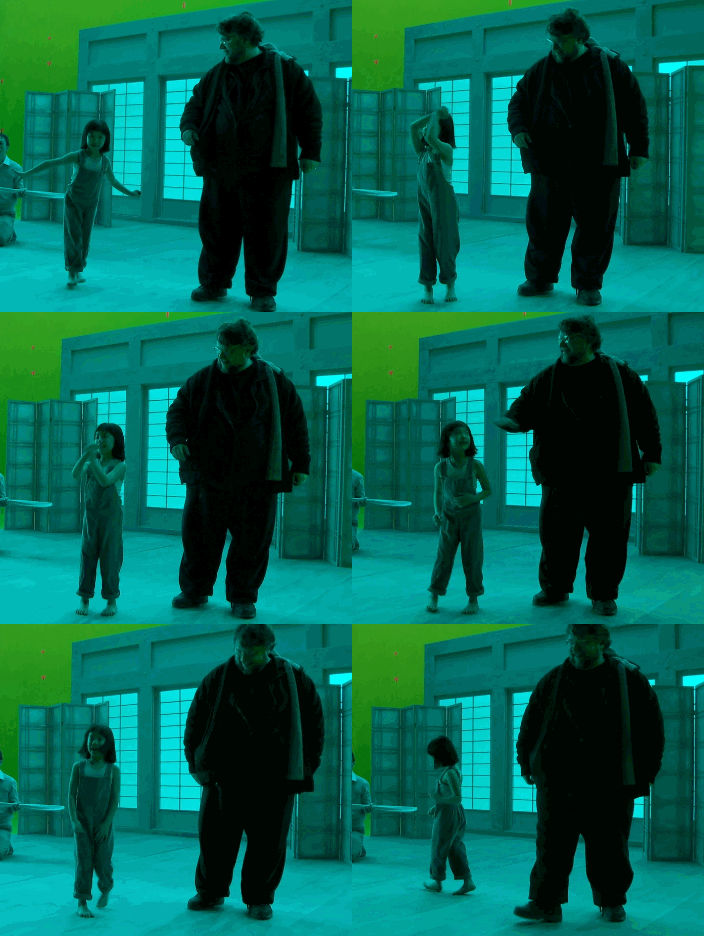
Japanese child actress Mana Ashida (little Mako) was embarrassed that she couldn’t pronounce Guillermo Del Toro’s name so he gave her special permission to call him “Totoro-san” instead.
anyway jeff bezos could eradicate homelessness. he could literally give each homeless person 100k and it would only take less than .5% of his entire wealth. what the actual god giving fuck
Why do you think they deserve it
Well shelter is a basic need, and would at the very least allow them a place where they can get back on their feet. Food water and shelter are necessary for a healthy body and psychology. There’s also the fact that they’re people too, and a little help goes a long way in making a decent community. There’s plenty of reasons
Yeah they need stuff, but why does every homeless person deserve 0.5% of someone’s income
You have five hundred apples, and just one day to eat them all.
You pass by a small crowd of hungry children, and decide you’d rather 455 apples go rotten than give them to some snotty brat who isn’t your problem.
It doesn’t matter how hard you’ve worked for your 500 apples, or that you aren’t the parent of any of those kids. in the moment you decide to walk away, it doesn’t matter why they’re hungry, or who owes who what.
You had the opportunity to help people, you had the ability to help people, you had the resources to help people. You had everything you needed to make a small, tiny little difference in someone’s life, and you decided not to.
What are you going to buy in your lifetime that’s worth more to you than your own humanity?
What are you going to buy in your lifetime that’s worth more to you than your own humanity


























 Chriss’ Home of Gifs, Squee, and Fandom Issues